Three acronyms get sold as alternatives to each other, and they are not alternatives. They are layers. Buying them in the wrong order is how an organization ends up with a very expensive stack that still misses the thing it was bought to catch.
The SIEM vs SOAR question in particular comes up as though it were a choice. It is not. One of them tells you something happened; the other acts on it. This article sets out what each of the three actually does. It also covers where XDR fits, what it gives up in exchange, and the questions that tell you which one you need next.
- SIEM collects, normalizes, correlates and retains. It observes. It does not act.
- SOAR turns a decision into an action without a human typing. It needs something to decide about.
- XDR detects and responds across a vendor-integrated set of sources. Narrower coverage, deeper action.
- SIEM vs SOAR is not a choice. A SOAR with no detection layer underneath it has nothing to orchestrate.
- None of the three is a team. Alerts nobody reads are not detection.
What each one actually does

- SIEM. A place where the logs from everything end up, with an engine that looks for patterns across them. Its value is breadth: it sees the firewall, the directory and the application at once, which is the only way some attacks are visible at all. It also holds the retention that compliance asks for.
- SOAR. Security orchestration, automation and response. It takes a decision and executes it: isolate the host, disable the account, open the ticket, enrich the alert with threat intelligence, notify the right person. Its unit of work is the playbook.
- XDR. Extended detection and response. Detection and response across a connected set of sources, usually from one vendor: endpoint, identity, email, cloud workloads. It is narrower than a SIEM by design, and in exchange it can act on what it sees without an integration project.
SIEM vs SOAR: the question behind the question
When somebody frames it as a choice, what they usually mean is one of two very different things, and it is worth finding out which.
If the problem is that you do not know what is happening, that is a SIEM problem. If the problem is that you know exactly what is happening and it takes forty minutes to do anything about it, that is a SOAR problem.
The second one only exists once the first is solved. A SOAR deployed over an immature detection layer automates the wrong decisions faster, which is worse than not automating them. That is the real answer to SIEM vs SOAR: the order is fixed, even when the budget arrives in the other sequence.
There is a second trap underneath it. SOAR playbooks encode decisions somebody has to have made first. If your team has not agreed what to do when a privileged account logs in from a new country, the automation will not agree it for them.
Where XDR fits, and what it gives up
XDR is the most useful of the three for an organization without a mature security team, and the most oversold.
What it does well: it arrives with detections already written, it correlates across the vendor’s own telemetry without an integration project, and it can respond on the endpoint immediately. For a team of three people that is a genuinely different outcome from a blank SIEM.
What it gives up is breadth. An XDR sees what its vendor’s sensors see. The legacy application, the appliance from another vendor, the SaaS platform with only an API, the mainframe: those are the blind spots. Attackers do not confine themselves to the telemetry you bought.
The practical pattern in most mid-sized organizations is XDR for depth on the endpoint and identity, and a SIEM for breadth and retention over everything else. SOAR comes last, once the alert volume justifies automating the repetitive decisions.
The one that is not a product
A SOC is people. It is the function that looks at what the tools raise, decides what is real, and acts. It can be yours, outsourced, or a mix.
This matters because every one of the three technologies above is bought on the assumption that somebody is watching. An organization that buys a SIEM without the staffing to triage it gets the retention and the compliance evidence, and not the detection. That is a legitimate outcome if it is the one you chose on purpose. It is an expensive surprise if it is not.
Which one you need next
Five questions, answered honestly, usually settle it without a single demo.
- 1 Can you reconstruct what an account did last Tuesday? If not, you have a visibility problem and the answer starts with a SIEM.
- 2 How long between an alert firing and somebody seeing it? If the answer is overnight, no technology fixes that. Staffing does.
- 3 How many alerts a week are handled by the same five steps every time? That number is the business case for SOAR, and it should be large before you build one.
- 4 Where does your telemetry stop? List the systems nothing is watching. That list decides whether breadth or depth is the gap.
- 5 What does compliance require you to retain, and for how long? Retention obligations usually settle the SIEM question regardless of the detection argument.
What buying them in the wrong order looks like
Two failure modes account for most of the waste, and both are recognizable early.
The first is the SIEM nobody reads. It was bought for an audit, three sources were connected, the rules are the defaults and the alert queue has four figures in it. It passes the evidence test and detects nothing.
The second is automation over guesswork. A SOAR wired into detections nobody tuned, isolating hosts on false positives until the business asks for the playbooks to be switched off. The technology works perfectly; the decisions underneath it were never made.
Where we fit
The layer most organizations actually need first is the one with the breadth and the retention, operated by people who already have the shifts covered. That is managed SIEM and security intelligence, and the team behind it is the SOC.
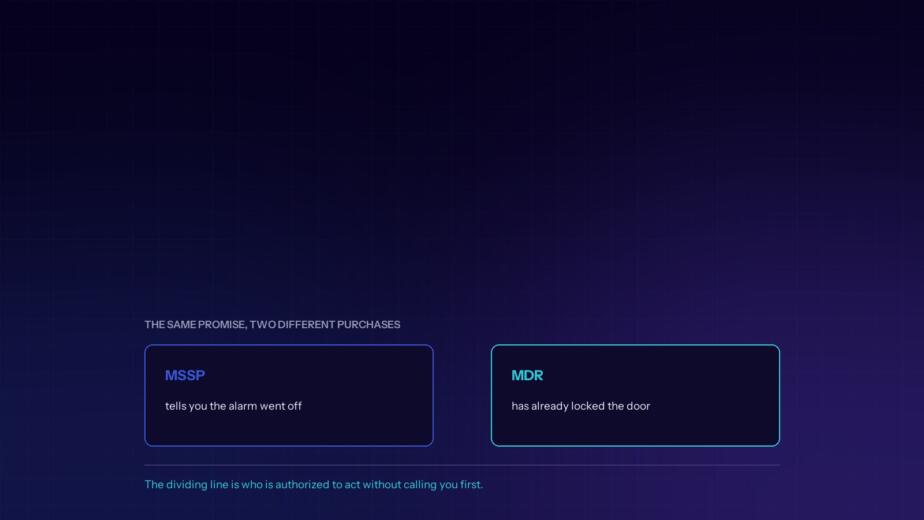
When the gap is the hunting rather than the alerting, it sits with proactive threat hunting, and when something has already happened, with DFIR. If what you are weighing is a service model rather than a product, the distinction worth understanding first is the one between MDR and an MSSP. Talk to the team.
Sources
- NIST, SP 800-92, Guide to Computer Security Log Management: the basis for what to log, how long to keep it and how to protect it.
- NIST, SP 800-61, Computer Security Incident Handling Guide: the response process that a SOAR playbook automates parts of.