ISO 42001 is the world’s first certifiable standard for managing artificial intelligence, and the question that brings most people here is whether it replaces ISO 27001. It does not. It answers a question ISO 27001 never asked.
ISO 27001 asks whether your information is protected. ISO 42001 asks whether anyone is accountable for what your AI decides. Those are different questions, audited separately and certified separately. This article covers what the standard is, who it actually applies to, what gets certified, and one thing worth asking before you hire anybody.
- It is ISO/IEC 42001:2023, published December 2023. 51 pages, committee ISO/IEC JTC 1/SC 42.
- It applies even if you do not build AI. Using it inside your services is enough.
- It is certifiable by a third party, like ISO 27001. It is not a best practice guide.
- The rules for who may certify you are newer than the standard: ISO/IEC 42006, July 2025.
- It does not replace ISO 27001 and it does not make you compliant with any law. They are different layers.
What ISO 42001 is, and what actually gets certified
It is a management system standard, from the same family as ISO 27001 and ISO 9001. That means it does not certify a product or a model. It certifies that your organization has a system for deciding how AI is used, who answers for each deployment, and what happens when something goes wrong.
ISO calls it an artificial intelligence management system, and the purpose of the standard is establishing it, implementing it, maintaining it and continually improving it. Continually is the operative word. This is not a report, it is something that has to keep running between audits.
If you already hold ISO 27001 this will sound familiar, and it should. Both use the harmonized structure of management system standards, so they integrate without rework: the same steering, the same internal audit and management review mechanics.
Who it applies to, which is the surprising part
ISO’s own definition is broader than most people expect. The standard is written for organizations that provide or use AI-based products and services.
Use. That is the catch. You do not have to train models or run a data science team. If you put an assistant inside your support desk, you are using AI. The same goes for classifying documents with a third party model, or letting a coding assistant write code that reaches production.
It applies to any size and any sector, public bodies included. There is no revenue threshold and no list of obligated industries, because ISO 42001 is not a law. It is a voluntary standard that becomes mandatory the moment a client, a contract or a tender asks for it.
How it differs from ISO 27001
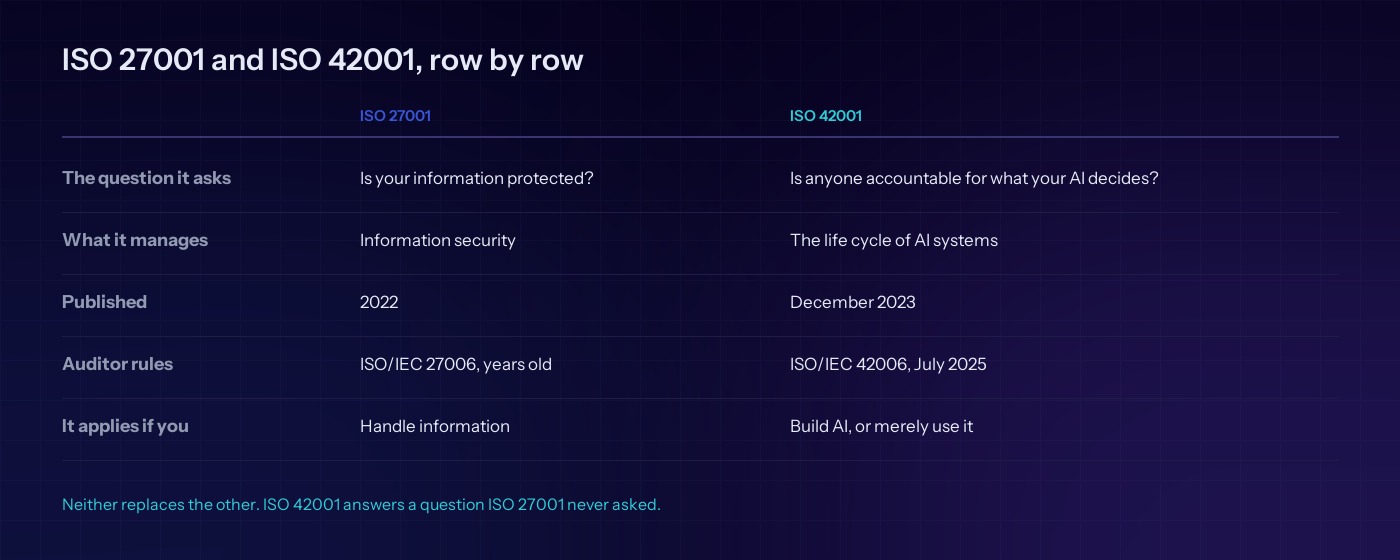
The usual confusion comes from both talking about risk and controls, so they look like the same thing with a different number. They are not, and the difference shows best in the question each one asks.
ISO 27001 protects the confidentiality, integrity and availability of information. Its risk is that someone sees, alters or takes down what they should not. You can have an AI system that is perfectly secure by that measure. And that same system can still make decisions nobody can explain, affect real people, and have no named owner.
That gap is exactly what ISO 42001 covers. Not the security of the system, but accountability for what the system does.
In practice they stack. ISO 27001 remains the basis for information security, and what certification to it actually involves does not change. On top of it, ISO 42001 adds governance of the AI that information feeds.
The full family, because the standard did not arrive alone
ISO 42001 is the certifiable one, but it came with company, and the two standards that followed are what make it workable.
- 1 ISO/IEC 42005, May 2025. Guidance for running AI system impact assessments: how a system affects individuals, groups and society across its whole life cycle. It is the conceptual equivalent of the impact assessment you already know from privacy work.
- 2 ISO/IEC 42006, July 2025. The requirements a body must meet to audit and certify you. It builds on ISO/IEC 17021-1, the general standard for certification bodies, and adds what is specific to AI.
The question to ask before you sign anything
Here is the detail almost nobody mentions, and the one most likely to save you money.
The standard was published in December 2023. The rules about who is competent to certify against it arrived in July 2025, a year and a half later. In that gap, ISO 42001 certificates were issued before the text defining the auditor’s competence even existed.
That does not make any certificate false. It does change the question you should be putting to whoever offers to certify you.
Ask two things in writing: who accredits the body that will certify you, and whether that accreditation is already assessed against ISO/IEC 42006. A certificate with no accreditation behind it is worth whatever the signature is worth, and your customer will look.
What it will ask of you in practice
Without quoting the clauses, which you have to buy, the work looks a lot like any management system, with three things specific to AI.
- A real inventory. Which AI systems exist in the organization, who approved them, what data they reach and who answers for each. This is the piece almost nobody has, and the first thing an auditor asks for.
- Impact assessment, not just risk assessment. Risk looks at what could happen to you. Impact looks at who else something could happen to. They are different exercises, and the second is the one that is missing.
- Continuous review. An AI system changes behavior without anyone touching it, because the data changes or the provider ships a new version. The standard assumes that, and expects you to review at a defined cadence.
What ISO 42001 does not do
Three things, worth stating because they get sold the other way around.
- 1 It does not make you compliant with any law. It is voluntary. It helps demonstrate diligence and it organizes the work, but no regulator accepts a certificate in place of meeting its own rules.
- 2 It does not replace ISO 27001. If you handle customer information, security is still the business of ISO 27001 and the controls underneath it.
- 3 It does not certify your model. It certifies your management system. Nobody is going to hand you a mark saying your model is right.
Where to actually start
With the inventory, always. Before thinking about certification, list what you already have running with AI inside it, including whatever arrived through the back door in third party tools.
That list usually surprises people, and it does double duty. The PCI Council published its own AI guidance in September 2026 and names ISO 42001 as a reference for governance and risk management. If PCI DSS applies to you, the inventory one asks for serves the other, and we covered what that guidance requires and what it does not.
Where we fit
Nordstern does not certify. Certification is issued by an accredited body, and that body has to be independent of whoever prepares you. What we do is the part before and the part after, which is where the project is won or lost.
The management system and the ongoing work live in cybersecurity as a service, which is the layer this stacks on. Access control for automated systems, the most delicate point in any AI deployment, is critical access control. The logging and monitoring any continuous review needs rests on managed SIEM, and keeping watch on what keeps appearing is vulnerability and exposure management. Talk to the team.
Sources
- ISO, ISO/IEC 42001:2023, Information technology, Artificial intelligence, Management system. Published December 2023, edition 1, 51 pages, committee ISO/IEC JTC 1/SC 42. The purpose of the standard and its scope of application come from there.
- ISO, ISO/IEC 42006:2025, requirements for bodies providing audit and certification of AI management systems. Published July 2025, building on ISO/IEC 17021-1.
- ISO, ISO/IEC 42005:2025, AI system impact assessment. Published May 2025.
- PCI Security Standards Council, “Security Considerations for AI Systems,” version 1.0, September 2026, which lists ISO/IEC 42001 among its governance references.